The proposed 2027 Medicare Physician Fee Schedule keeps shifting pay toward preventive and chronic care while the conversion factor drifts lower. For independent practices, that arithmetic reaches patient access, healthcare costs and a physician’s retirement timeline.

A proposed Medicare payment update may not sound like front-page news, but for independent healthcare providers, it could shape the future of their practices for years to come. And, examining these changes is very important for the future of healthcare. Changes in reimbursement often lead to changes in business strategy and planning, which ultimately influence patient access (think plan networks), healthcare costs, and eventually retirement planning.
We’ll also look at what drove markets this week as investors balanced earnings season, interest rates, and inflation concerns. Finally, we’ll explore why strength, not just longevity, may be one of the most valuable retirement assets you can build.

Every year, Medicare updates the way it pays physicians. Most changes barely make the news.
This year’s proposal is somewhat different.
CMS recently released its proposed 2027 Medicare Physician Fee Schedule, continuing a long-term shift toward paying more for preventive care, chronic disease management, and value-based care while reducing or restructuring reimbursement for some procedure-based services. The proposal also reflects broader changes in how Medicare develops payment policy and evaluates physician services. These changes won’t affect every specialty equally, but they reinforce a trend that independent healthcare providers have been navigating for years.
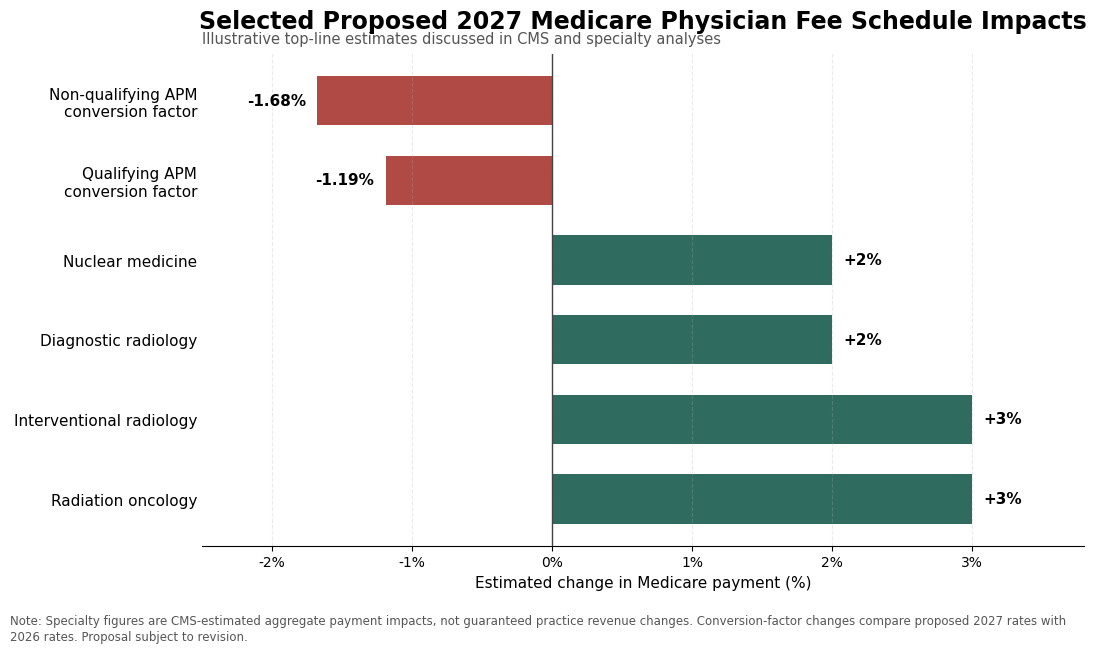
As you can see from the simple bar graph based on current estimates, radiation oncology and interventional radiology could see Medicare payments increase by approximately 3%, while diagnostic radiology and nuclear medicine could receive increases of roughly 2%.
At the same time, the broader Medicare conversion factors, which are the baseline amounts used to calculate physician payments, could decline compared with 2026. The proposed conversion factor is approximately 1.19% lower for clinicians participating in qualifying Alternative Payment Models and about 1.68% lower for other clinicians.
In simple terms, some specialties may benefit from changes to the way individual services are valued even while the general payment formula moves lower. That is why the effect on a particular practice will depend on its specialty, services, billing mix, Medicare participation, and involvement in value-based payment programs.
These percentages represent estimated changes in Medicare payments, not guaranteed changes in a practice’s total revenue. However, they demonstrate how even a relatively small reimbursement adjustment can influence cash flow, staffing decisions, expansion plans, practice valuations, and eventually a physician’s retirement timeline. The physician fee schedule for 2027 is expected to be finalized sometime in November of 2026.
For many providers, this isn’t simply about reimbursement.
It’s about the future of their private practice.
Healthcare has become as much a business challenge as a clinical one. In fact, I would say the business challenge is bigger than the clinical challenge.
Independent physicians, dentists, optometrists, psychiatrists, plastic surgeons, and pharmacy owners continue managing rising payroll costs, increasing technology expenses, cybersecurity investments, compliance requirements, and administrative burdens, all while reimbursement often struggles to keep pace.
When Medicare changes how it pays providers, private practice owners begin asking tough questions:
These aren’t just emotional decisions.
They’re economic ones.
Procedure-heavy specialties may feel more pressure than physicians focused on longitudinal patient management. Even providers who don’t rely heavily on Medicare watch these changes closely because commercial insurers frequently follow Medicare’s lead when designing payment models.
One reimbursement adjustment rarely stays isolated.
Patients often don’t see these business decisions and never worry about them. After all, it’s not their business. They just want good (affordable) healthcare.
They simply experience the outcomes.
However, over time payment changes can contribute to:
None of these outcomes happen overnight. Instead, they accumulate gradually as practice owners adapt to an increasingly complex business environment while also navigating advances in medicine.
Many physicians entered medicine to care for patients, not to spend hours navigating prior authorizations, peer reviews, denials, appeals, payer contracts, or changing reimbursement rules. As those pressures mount, some providers conclude that reducing insurance participation allows them to spend more time with fewer patients while maintaining financial stability.
For some patients, that can be a welcomed experience. In fact, depending on the procedure, cash pay can actually save you money and creates less headache for the physician and staff.
But for others, especially retirees on fixed incomes, it may create new affordability challenges.
This is where healthcare policy becomes personal.
Healthcare providers often view their practice as their largest retirement asset. Reimbursement changes can influence practice profitability, business enterprise value, exit or succession planning, and the timing of retirement.
Most healthcare providers think they will get more out of their practice than what they really receive. The main reason for this is they didn’t plan far enough ahead.
For retirees and future retirees, however, the effects are different but equally important.
If more providers move toward cash-pay models, healthcare expenses may become a larger line item in retirement budgets. This has become more of a trend in dental and optometry practices.
If independent practices continue consolidating, healthcare inflation could remain elevated.
If physician shortages expand in certain communities, retirees may increasingly choose where to live based on healthcare access rather than climate alone.
These aren’t just healthcare decisions.
Holistically, they’re retirement planning decisions.

This creates a ripple effect. For example, CMS adjusts reimbursement → Independent practices reassess profitability → Business models begin changing → Patient access evolves and shifts → Healthcare costs shift → Both providers and retirees revisit their long-term financial plans based on business and personal priorities.
This is the purpose of The Margin. To bring to light how everything is connected so one important decision isn’t made in isolation of other important decisions.

Markets entered one of the busiest weeks of the summer with investors weighing corporate earnings, the Federal Reserve’s policy meeting, inflation data, and second-quarter economic growth reports, all arriving within a few days of one another.
Major indexes traded in a relatively narrow range as investors rotated away from some technology names while favoring more defensive sectors. Concerns about elevated AI-related valuations pressured semiconductor stocks, while strong earnings from several large companies helped offset broader weakness.
Treasury yields remained elevated as investors continued to debate whether inflation has cooled enough for the Federal Reserve to remain on hold. Many bond managers are emphasizing shorter-duration, higher-quality investments while waiting for greater clarity on inflation and monetary policy.
Oil prices retreated from recent highs as geopolitical tensions eased somewhat, helping reduce immediate inflation concerns. Energy markets remain volatile, however, and could quickly change if global tensions escalate again.
Precious metals have remained relatively range-bound as investors weigh higher interest rates against ongoing geopolitical uncertainty. Bitcoin has also traded without a clear trend, reflecting the broader “wait-and-see” attitude across financial markets.
Three themes continue to dominate investor thinking:
1. The Federal Reserve
Markets largely expect the Fed to leave short-term interest rates unchanged for now, but investors remain focused on every comment regarding inflation and the possibility of another rate increase later this year.
2. Corporate Earnings
Second-quarter earnings season is providing insight into consumer spending, business investment, and profit margins. Investors aren’t simply looking for companies to beat expectations. They’re watching management forecasts for signs of economic slowing.
3. Inflation
Inflation has moderated from its peak but remains above the Fed’s long-term target. Energy prices, labor costs, and geopolitical developments continue to create uncertainty about the path forward.
Higher interest rates don’t just affect Wall Street.
They increase borrowing costs for healthcare providers financing:
For independent practice owners, higher financing costs can delay growth plans or reduce future practice valuations.
For retirees, elevated rates present both opportunities and challenges. Cash savings and short-term fixed-income investments may offer more attractive yields than they have in years, while borrowing for a home or other large purchase remains relatively expensive.
Again, one market trend creates ripple effects throughout the economy.
I’ll be paying particularly close attention to:


Most retirement planning conversations focus on finances, and they should.
But one of the greatest predictors of independence in retirement isn’t your investment portfolio.
It’s your physical health.
After age 50, adults naturally lose muscle mass unless they actively work to maintain it. This gradual decline, known as sarcopenia, can affect balance, mobility, bone health, and the ability to perform everyday activities.
The encouraging news? Strength can be improved at nearly any age.
Research consistently shows that resistance training helps older adults preserve muscle, improve balance, reduce fall risk, maintain bone density, and support overall quality of life by fighting off chronic disease.
That doesn’t require you to become a bodybuilder.
These simple habits can make a meaningful difference:
Financial independence means little if your health limits your ability to enjoy it.
One of the best investments you can make today won’t appear on your brokerage statement.
It will show up in your ability to travel, play with grandchildren, carry groceries, and remain independent for years to come.
Don’t think of exercise as something that helps you live longer.
Think of it as something that helps you live better.
That’s a return worth compounding.
The biggest changes rarely begin with headlines. They begin with small shifts in policy, markets, healthcare, or our daily habits that gradually reshape the future for everyone. My goal each week is to help you connect those dots so you can make more informed decisions with confidence and clarity.