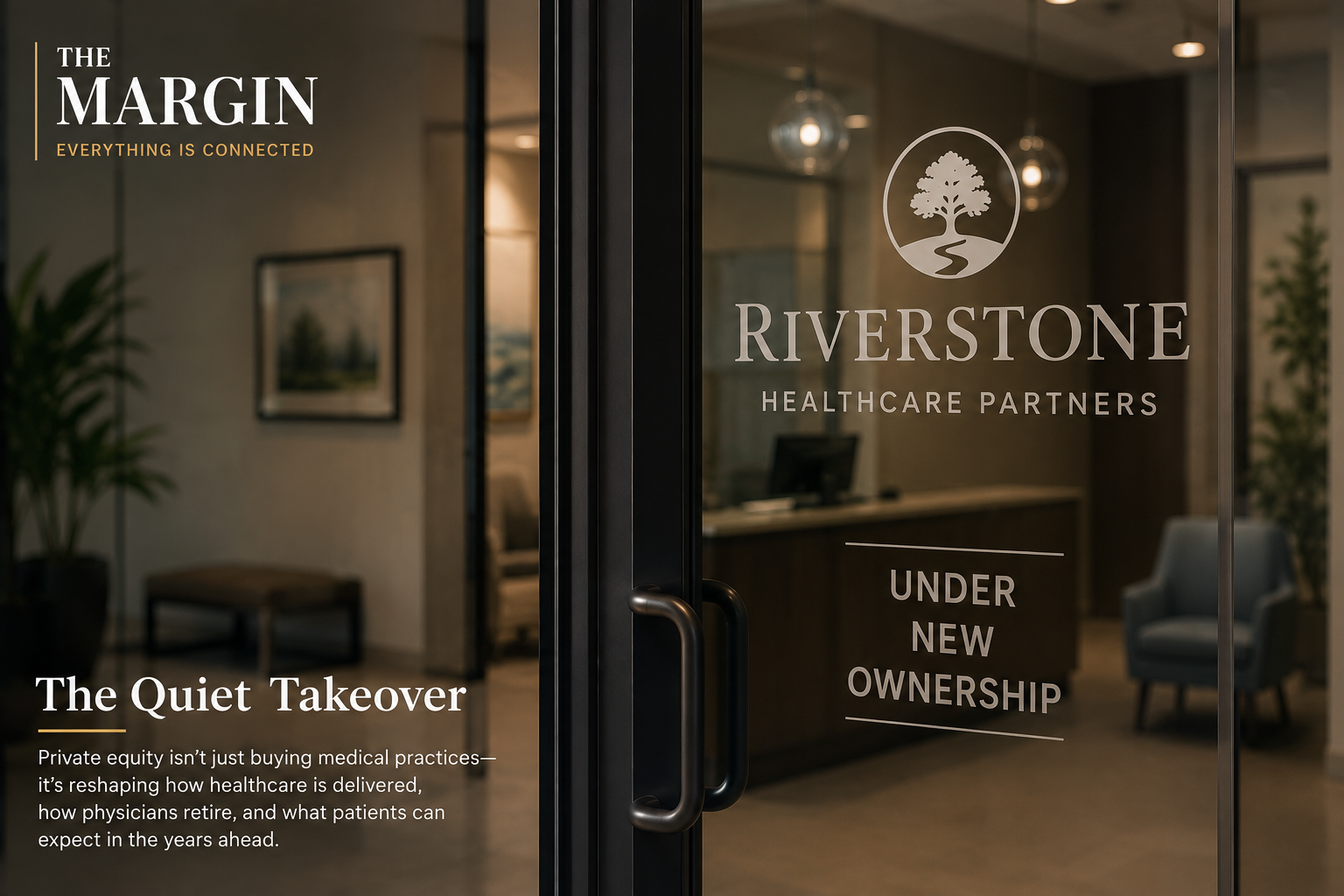
The waiting room looks the same, but the owner may not be. Private equity has become one of the most influential owners of physician practices, and the change in incentives eventually reaches patient care, healthcare costs and retirement planning.
Every year, thousands of physicians and healthcare practice owners make one of the most important financial decisions of their careers: whether to remain independent or sell their practice.
But the buyer isn’t another physician or another healthcare system in the area. It’s a private equity firm.
Private equity (PE) investment is fast becoming one of the most significant forces reshaping healthcare, and it’s not because it changes medicine overnight. It changes ownership, incentives, and long-term business decisions. Those changes, over time, can influence a patient’s quality of care, healthcare costs, and even further down the road, retirement planning decisions.
In this article, I’ll explore why PE continues investing in medical practices, what happens after a sale to a PE firm, and why this trend matters whether you’re a practice owner or simply someone planning for retirement.
Imagine walking into your doctor’s office for your annual checkup thinking nothing has changed. Everything seems normal, like it has been for years.
The receptionist knows your name. Your physician is still there. The waiting room looks exactly the same. From the outside, nothing appears different. But behind the scenes, ownership has changed.
Your physician may now work for an organization backed by private equity, a type of investment firm that purchases businesses with the goal of growing their value over time and eventually planning a profitable exit from the practice.
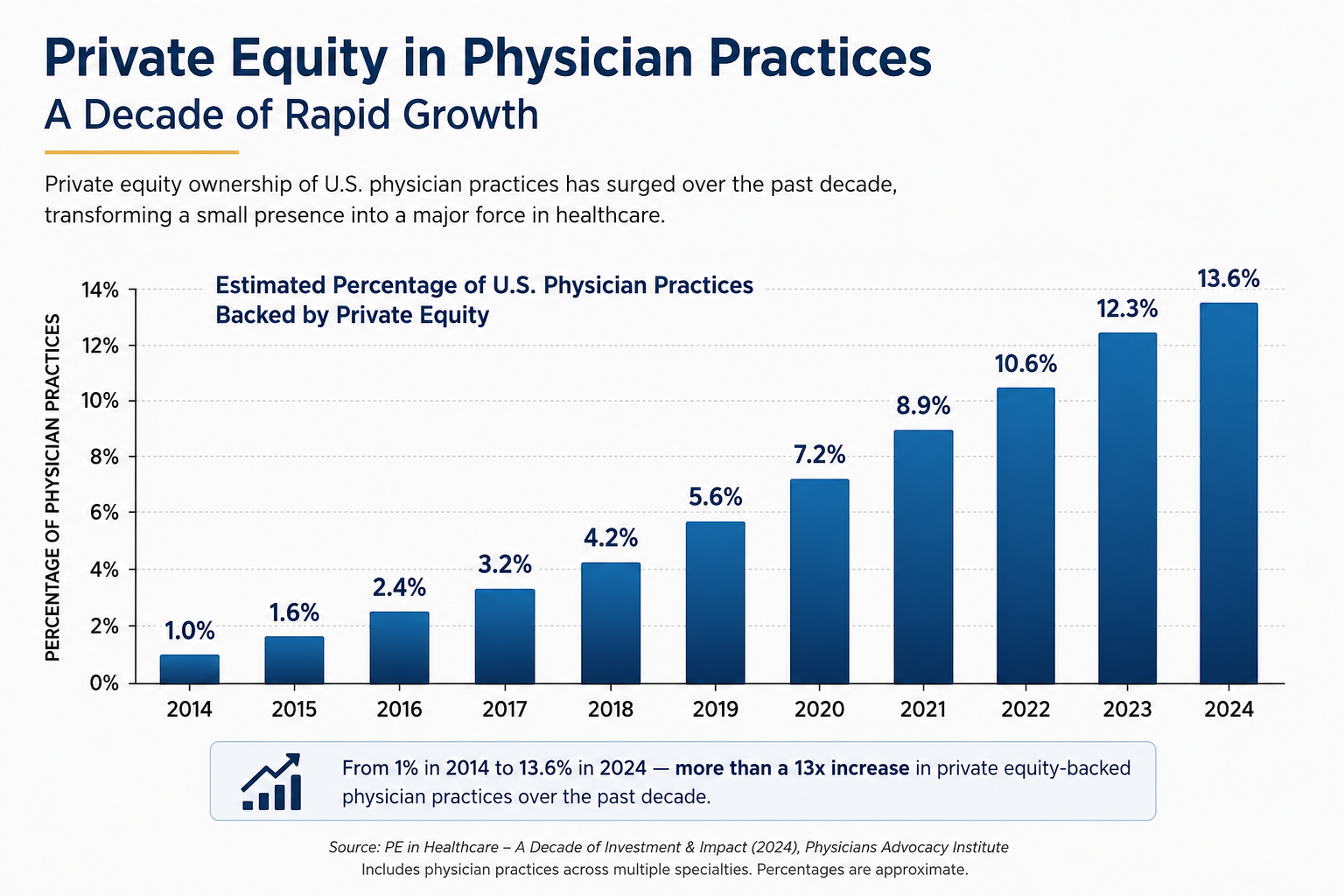
Over the past decade, private equity has become an increasingly influential owner of physician practices across many specialties, including dermatology, ophthalmology, gastroenterology, orthopedics, anesthesiology, cardiology, urology, and dentistry.
For some physicians, selling represents an opportunity to sell a profitable asset they have grown over several years that can help propel them into retirement.
For others, it’s a necessity due to a financial, family or health issue.
For patients, it’s often invisible.
Yet the ripple effects of a PE purchase can be significant for the practice and the patients.

Healthcare has become one of the most attractive industries for investors.
Here’s why:
Demand for healthcare is increasing at a rapid rate. America’s population is aging and healthcare spending continues to grow. In fact, the statistic I’ve heard and read for the past five years is that there are 10,000 people turning 65 every day. Recently, that number has increased to 11,000.
And the basics of supply and demand apply here as well. There’s a big demand for healthcare and the supply is dwindling somewhat with fewer healthcare practitioners available to take care of this aging population. Then, of course, quality healthcare becomes even more expensive. Then healthcare and Medicare plans adjust accordingly in their schedule of benefits, and this adjustment doesn’t favor the patient.
Private equity knows what’s happening in healthcare and sees an opportunity.
Medical technology continues advancing. And despite economic cycles, people still need healthcare if they plan to live longer.
Private equity firms also recognize another opportunity:
Many physician practice owners are approaching retirement.
After decades of running a practice, many physicians find themselves facing increasing administrative burdens:
Owning a practice has become more complicated than simply practicing medicine.
For some physicians, selling allows them to reduce business responsibilities and stress while continuing to see patients.
Others view the sale as a very important piece to their retirement strategy.
I’ll start by saying every physician’s situation is different.
Some simply want to slow down. Others have no successor. Some want access to better technology or stronger negotiating power with insurers, and can do this by selling to PE and working for a larger healthcare system or physician group.
Some realize their practice has become more valuable today than it may be five years from now.
Selling isn’t always about maximizing wealth. As mentioned before, sometimes it’s about reducing stress and improving the overall quality of their lives.
That’s an important distinction.
Private equity ownership doesn’t automatically mean better or worse healthcare for that matter. It simply changes the incentives.
A larger organization may provide:
Those improvements can benefit both physicians and patients.
However, ownership changes can also introduce new priorities. Investors generally seek operational efficiency and long-term financial returns.
That may translate into:
Whether those changes improve care often depends on how the organization balances financial goals with clinical decision-making.

Patients often don’t know when ownership changes. But they will probably notice subtle differences.
Appointments may become easier to schedule through new technology. Additional specialists may become available within the same network. Billing processes may become more streamlined.
At the same time, patients may also experience:
Most patients simply want good care from a physician they can trust.
Ownership changes don’t eliminate that goal. But they can influence how care is delivered.
This is where the story becomes personal for patients and physicians alike.
For many physicians, their medical practice represents the largest asset they’ll ever own.
It’s not simply a place to work. It was something they spent years building. It’s their “baby.”
It’s part of their retirement plan.
A practice sale raises questions that extend far beyond the purchase price:
These decisions often determine whether retirement feels financially secure or unnecessarily stressful.
Planning at least five years before a sale is often far more valuable than reacting afterward.
For patients, they now need to determine if they can continue to see a physician or nurse practitioner at the healthcare practice that was recently sold. Did the practice go out of network? Did quality of service decline? Did practice staff change?

Private equity investment → Medical practice acquisition → Changes in practice operations → Changes in physician incentives → Changes in patient experience → Practice valuation and retirement timing → Long-term financial planning.
Everything is connected. Nothing happens in isolation.

Markets continued digesting corporate earnings, interest rate expectations, and signs that inflation remains stubborn in some areas while cooling in others. Investors also continued monitoring healthcare policy developments that could affect providers, insurers, and patients.
Major indexes remained near record levels as investors weighed strong corporate earnings against concerns that stock valuations, particularly in technology, have become increasingly expensive.
Treasury yields remained elevated as investors continued debating when the Federal Reserve might begin reducing interest rates. Higher yields continue offering attractive income opportunities for conservative investors while increasing borrowing costs for businesses.
Precious metals remained supported by geopolitical uncertainty and continued central bank demand, though higher interest rates limited stronger price gains.
Commercial real estate continues facing challenges from higher financing costs, while residential housing remains constrained by affordability and limited inventory.
Cryptocurrency markets remained volatile as institutional adoption continues expanding alongside evolving regulation.
Higher borrowing costs don’t just affect homebuyers.
Healthcare practices financing new equipment, office expansions, acquisitions, or technology upgrades continue paying significantly more than they did just a few years ago.
Combined with reimbursement uncertainty, these financing costs influence whether practices expand, merge, or sell.


Most people spend decades planning for retirement.
Far fewer spend time planning what they’ll do once they get there.
Research consistently shows that one of the strongest predictors of happiness in retirement isn’t simply wealth. It’s having a sense of purpose.
For physicians, dentists, pharmacists, and other healthcare professionals, this transition can be especially challenging. Many have spent their entire careers caring for others, solving problems, and making important decisions every day. And they’ve simply forgot how to take care of themselves.
Retirement can bring financial freedom, but it can also create an unexpected loss of identity.
That’s why the most successful retirees don’t just retire from something.
They retire to something.
Whether it’s mentoring young professionals, volunteering, traveling, spending more time with family, serving on nonprofit boards, or finally pursuing a long-neglected hobby, having meaningful activities creates structure, social connection, and a continued sense of contribution.
A retirement plan should answer more than one question.
Not just:
“Will I have enough money?”
But also:
“How do I want to spend the next chapter of my life?”
Before you retire, write down three things you’re excited to wake up and do on Monday morning.
If you can’t answer that question yet, your retirement plan may still be incomplete.
Ownership changes. Markets fluctuate. Policies evolve. Technology advances.
Yet the biggest financial decisions often come down to understanding how one change influences another.
Whether you’re managing a medical practice, preparing for retirement, or simply trying to make better financial decisions, seeing the connections before everyone else can make all the difference.
This is what The Margin brings to light.

